
Intermediate/Advanced Oil Painting (Abstract & Surreal Art Focus) - Arturo Perez
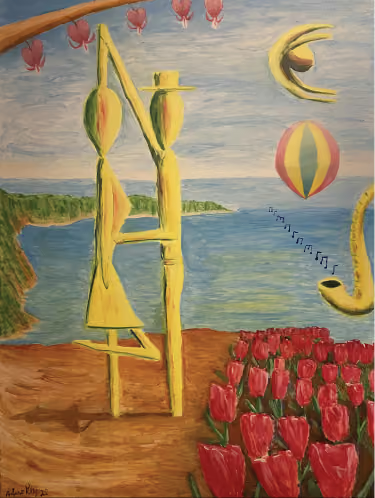

This intermediate/advanced oil painting course is designed to strengthen foundational skills while encouraging students to move beyond direct observation toward abstraction, surrealism, and a more personal visual language. Building on color theory, students explore the fundamentals of design, composition, balance, and spatial relationships through still life, natural forms, imagination, and internal references. Emphasis is placed on developing visual awareness, perceptual acuity, and individual artistic direction. Through guided exercises and independent exploration, students learn to transform observed forms, ideas, and imagery into abstract or surreal compositions while gaining the confidence to develop a more independent painting practice.
Supplies:
Drawing Materials: pencil and eraser, small, 8x10 or 9x12, drawing pad
Basic oil paints colors (more is fine):
• Titanium White or titanium zinc mix (large tube, 200 ml.)
4 Basic primary colors in 37 ml tubes: cadmium yellow light, cadmium red medium,
yellow ochre, permanent alizarin crimson, ultramarine blue (can also called french
ultramarine) plus transparent red oxide.
And 1 acrylic paint: Acrylic Burnt Sienna, Burnt Umber
Brands for oil paints could be Gamblin, Windsor Newton, Michael Harding, M. Graham,
Rembrandt, Old Holland, Utrecht, or Vasari. Do not buy cheap or “student grade” paint.
Stretched oil primed canvas Two (2) -18”x24” size minimum or oil primed linen canvas
panels are best for oil painters.
Panel suggestions are (Centurion, New Traditions, Raymar, Raphael Premium Archival
Pissarro Panels). Other possibilities are Ampersand Gessoboard or, for the least
expensive, you can use gessoed paper. Acrylic primed canvases are best for acrylic
paint. Note: cardboard canvas boards, they are going to curl and are probably never
worth your time.Sizes 10 x 20” or 12 x 16.
Palette knives (2) Flexible metal, triangular in shape; 1 small size 1/4” and 1 medium
1/2” long.
Brushes: flats, sizes. 4, 6, 8 and 10, flats, or any preferred shape, long or short. The
smaller the paint surface the smaller the paint brush size.
Viewer or window – can be made from cardboard or construction paper or View Finder
or Catcher https://www.jerrysartarama.com/view-catcher
Palette for mixing: Glass, plexiglass, wood, or large grey disposable.
I recommend Artist’s Palette Seal box made by Masterson that you can place in your
refrigerator or freezer saving your paint from week to week. A good brand and size is a
12 x16 Grey New Wave POSH Glass Artist Palette https://www.jerrysartarama.com/
new-wave-posh-glass-tabletop-palettes (made to fit Masterson box) that is easily
cleaned with a straight edge razor.
Gamsol odorless or Odorless Turpenoid solvent ONLY.
Small container for solvent.
Brush washer - Metal brush washers are expensive, but really worth it.
https://www.jerrysartarama.com/newton-air-tight-deluxe-brush-washer or
https://www.jerrysartarama.com/da-vinci-air-tight-brush-washer
Rags and a roll of paper towels
Plastic bag for garbage and clip for attaching to easel.
Basic Palette (cool)
• *This limited palette is sufficient for most paintings– it is a good starting palette if you don’t
already have oil paints
CERULEAN BLUE
CADMIUM YELLOW MEDIUM
CADMIUM RED MEDIUM
ULTRAMARINE BLUE
ALIZARIN CRIMSON
TITANIUM WHITE (large tube)
ULTRAMARINE VIOLET
VIRIDIAN
———— additional colors —-
Mars Black
Quinacridone Red
phthalo blue
phthalo green
Cobalt blue
Cobalt Teal
Zinc white
Prussian blue
• A painting medium such as Galkyd, Liquin, or Neo Megilp.
• Solvent (optional) Gamsol, or other odor-less turpentine substitute for thinning paint and clean
up.
• baby oil or safflower oil (for brush clean up)
NOTE: solvents (gamsol, turpentine, turpenoid etc...) are not absolutely necessary! However,
you are welcome to bring some. Oil brushes can be cleaned with baby/vegetable oil, and soap
and water. Well cleaned brushes will last until you wear them out!
• Rags or good quality paper towels (like the blue automotive towels).
• Enamel, glass, or disposable palette. (Dollar store baking sheets, glass plates also work well)
• Palette knife.
• Brushes- various sizes (ie. 2,4,6,8,10,12,14) ...Brights or filberts. A couple of rounds (small or
medium) maybe be useful. Sable (synthetic), natural white bristle or other Synthetic mixed
brushes are recommended. There are some quality value packs of a variety of sizes and types
available at most art stores are a good to start.
• Painting support: You will need a canvas or other rigid support to paint on. Canvas (stretched)
or wood (luan ¼” plywood or other wood panel), various sizes. We will start with smaller
compositions (8’x 10” or 9”x12”). Oil painting paper or canvas panels would be perfect to start
on. You may choose either a rectangular canvas or a square format. You will receive more
information before that start of class concerning materials and painting supports.

Arturo Perez
Arturo Perez has has been teaching for over 25 years (K-12 to adults to seniors), has a Bachelor Degree from UNO in both Fine Arts and Science, has a Master of Fine Arts degree from Pratt Institute, and also volunteers at WWOZ, Creative Arts New Orleans (CANO) and Creative Industries. He continues to be involved in art and dance education teaching classes, workshops, private lessons, exhibiting work, and performing.
Contact Us
Fields marked with an * are required